
Three time zones, two closings, one moving truck. The puzzle sitting on your kitchen table right now has the agent question sitting right in the middle of it.
Most sellers handle the move itself just fine. Where things fall apart is the part where you try to find a realtor in a market you’ve never driven through, for a house you’ll be gone from before the first showing. I’ve bought houses from people in exactly that spot for years. The pattern repeats.
Why Do You Need to Find a Realtor in Another State
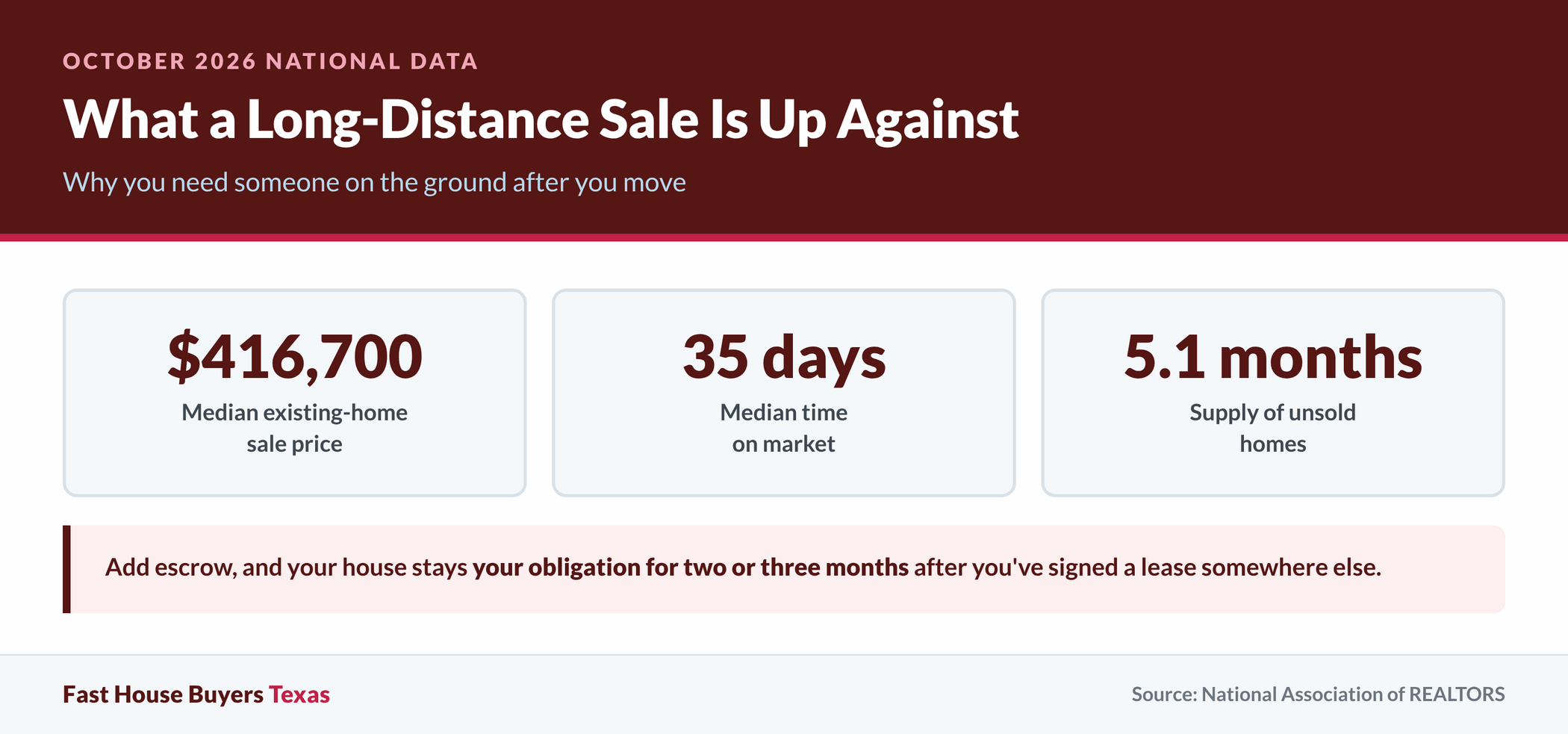
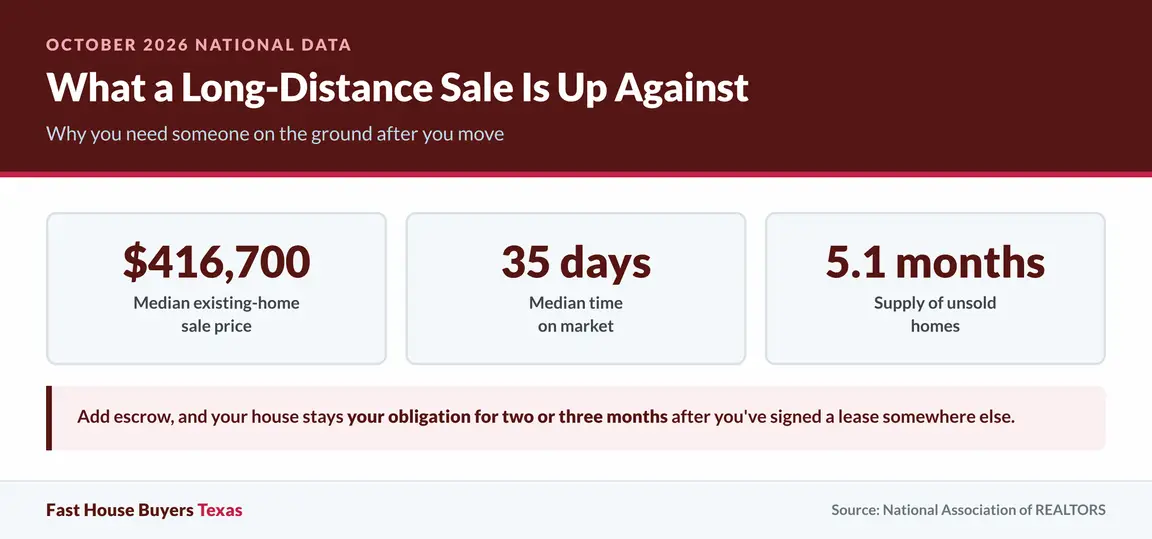
In October 2026, the median existing home in America sold for $416,700, according to the National Association of REALTORS. Homes sat a median of 35 days on the market before going under contract. Thirty-five days is just the midpoint, so plenty of houses take longer to find a buyer. Add escrow, and your house is a live obligation for two or three months after you’ve signed a lease somewhere else.
The gap is the whole reason to find a realtor on the receiving end of your move, or on the leaving end, or both, because somebody has to open the door for the inspector. Somebody has to notice the water stain that showed up in the hallway.
Relocating sellers often think they can run a sale by phone. Parts of it, sure. Nobody can walk a buyer’s agent through the crawlspace from 1,400 miles away, and nobody can smell a basement over the phone.
A family in McAllen ran into this not long ago. They’d moved for work. The contractor’s bid for the kitchen they were told to “update before listing” came in higher than what the kitchen would have added in value. They only discovered this after paying for a second opinion. I bought it with the original cabinets in place, and they stopped bleeding money on a house they no longer lived in.
The second reason to find a realtor before you leave is coordination. Your buying timeline and your selling timeline are two separate trains, and you’re only driving one of them. Sellers who line up representation early tend to keep those trains from colliding.
What Makes Out-of-state Realtor Searches Different
A seller called me from a hotel in Charlotte, three days into a new job. She had a vacant house back in the Rio Grande Valley and a lockbox code she’d given to an agent she’d met once. By week six, that agent had stopped returning calls and the yard was knee-high.
Locally, you hear things. Your neighbor mentions the agent who sold the corner house in nine days. You drive past signs. None of that exists when you try to find a realtor from halfway across the country.
A two-hour offset turns a same-day answer into a next-day answer, and buyers in a 5.1-month supply market don’t wait around politely as you catch up. October 2026 inventory stood at 5.1 months, the highest since November 2015, up from 4.4 months a year earlier, so slower markets punish slow sellers harder than hot ones do.
I’m not saying agents cheat distant clients. Most don’t. Still, accountability loosens when nobody’s going to swing by the office, and the agent who’d never skip a Saturday open house for a neighbor will reschedule one for a stranger in another state.
Your paperwork crosses state lines too. Disclosure forms, attorney-closing requirements, and transfer rules differ from state to state, so an agent licensed where your house sits is handling documents an agent elsewhere may never have seen.
Have you thought about who physically holds your keys during all this?
Where to Find a Realtor Licensed in Another State
Scroll a listing portal, pick the smiling face at the top of the results, done. Those top placements are usually paid advertising slots, so paying for placement tells you an agent has a marketing budget, not that she priced eleven houses correctly last quarter.
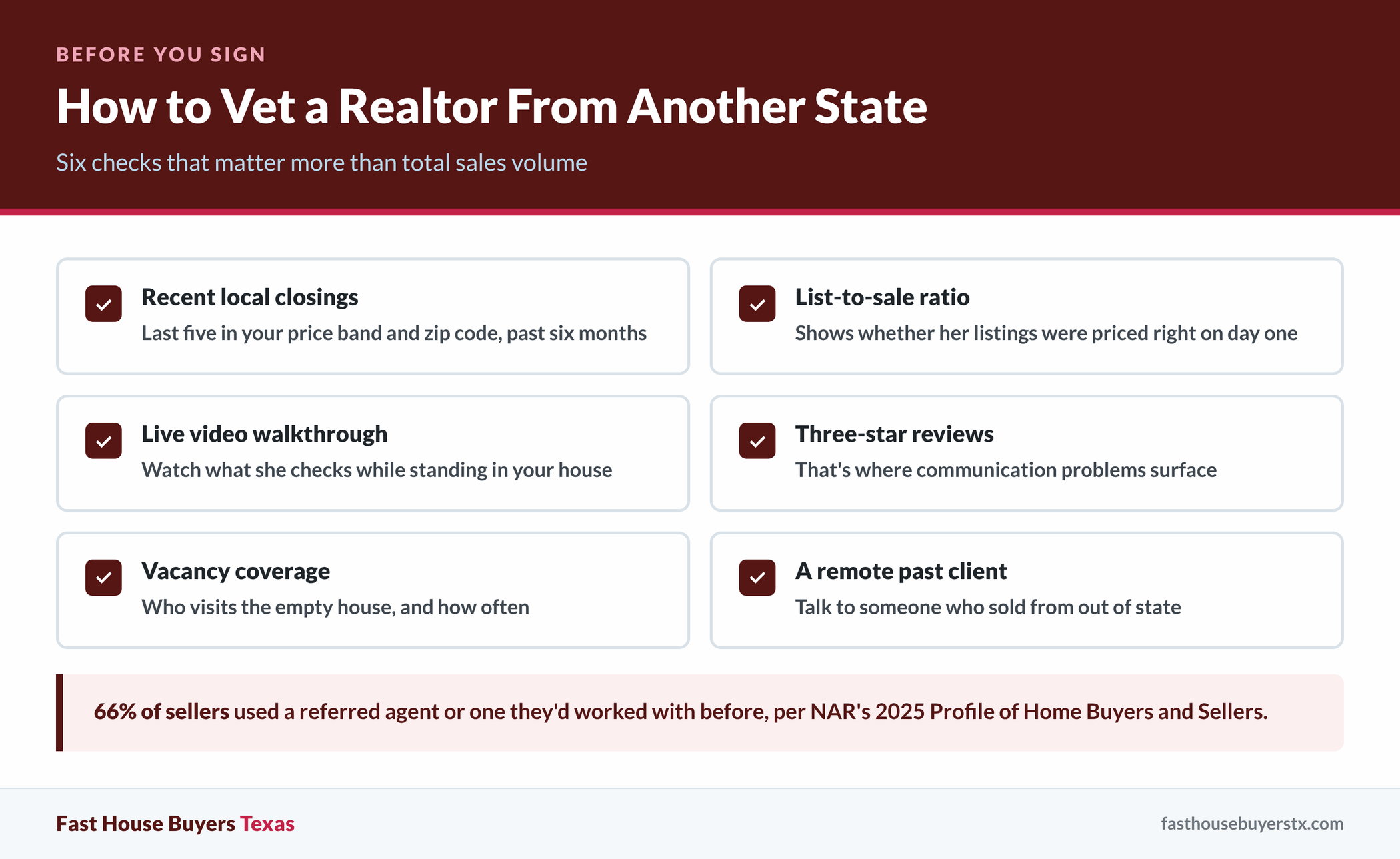
Referrals outperform everything else, and the data is lopsided. NAR’s 2025 Profile of Home Buyers and Sellers found that 66% of sellers either used an agent referred to them or went back to an agent they’d worked with before. Your current agent can refer you into the destination market, and agent-to-agent referrals carry a reputational cost that a lead form never does.
State license databases are the step people skip. Every state runs a licensee lookup through its real estate commission, so you can confirm an active license and see whether discipline has been recorded. The Association of Real Estate License Law Officials keeps a directory of every state commission at arello.org, which beats guessing at the right agency name.
If your employer is paying for the move, ask whether its relocation program can help you find a realtor. Those programs are built around corporate transfers, and they’re decent at the logistics piece.
Here’s where I’d push back on common advice: don’t limit yourself to agents, period. If your house needs work you can’t supervise remotely, a direct buyer may serve you better than any listing. We handle Texas properties ourselves at Fast House Buyers Texas, and plenty of relocating owners come to us after running the math on repairs they’d be managing by text message.
Can One Realtor Work in Two States
So the practical question underneath all of this is whether your current agent can just come with you. Occasionally yes. Usually no, and the reason is structural.
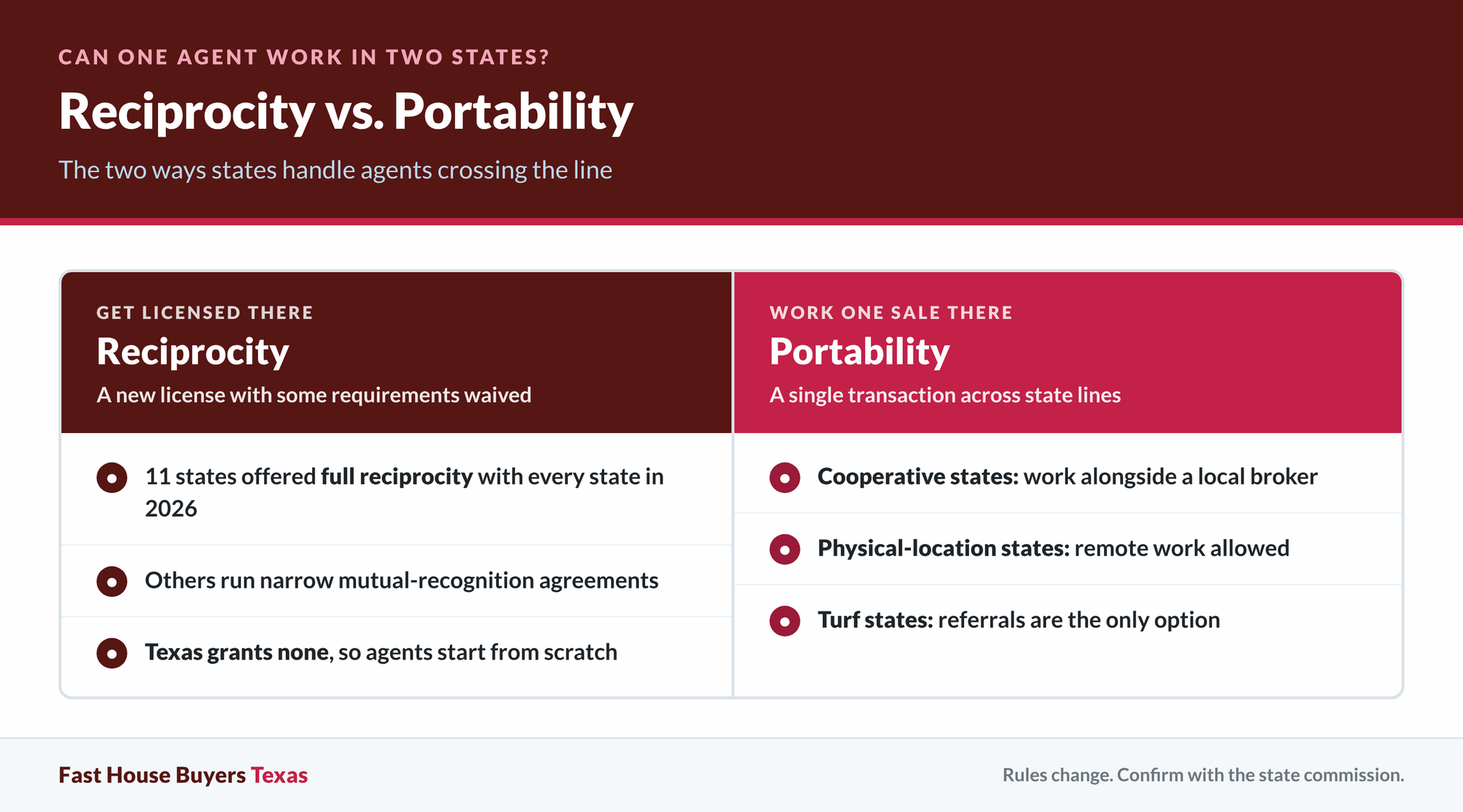
An agent licensed in one state isn’t automatically licensed in the next, so states handle crossing that line through two different mechanisms. Reciprocity means getting licensed in the new state with some requirements waived. Portability means working a single transaction there.
Portability breaks down into three models: cooperative states, physical-location states, and turf states. A cooperative state lets an out-of-state agent work a sale alongside a local broker, even in person, while a turf state bars out-of-state agent activity outright, leaving referrals as the only option. Physical-location states sit in between, allowing remote work on a transaction without entering the state to conduct business.
No two states handle reciprocity the same way. Eleven states offered full reciprocity with all other states in 2026: Alabama, Colorado, Delaware, Georgia, Kansas, Kentucky, Maine, Mississippi, Missouri, Virginia, and Washington. Others run narrow mutual-recognition agreements, and a handful grant none at all.
Dual-licensed agents do exist, though they’re rarer than relocation marketing suggests. Before you hire one on that basis, pull up both states’ licensee lookups and confirm both licenses yourself.
When your agent can’t follow you, the referral route still works in your favor if you need to find a realtor. A referring agent typically earns a slice of the receiving agent’s commission, which means she has a real stake in sending you to someone competent rather than someone convenient.
How Do You Vet a Realtor Before Moving to Another State
For years I told sellers to check total sales volume, and that advice was close to useless. An agent can move forty houses a year and still be wrong for your situation, because volume measures a team’s lead flow rather than one person’s attention.
An agent who sells $800,000 new builds in a master-planned community isn’t the right fit for a 1960s ranch with a bad roof. When you find a realtor who looks promising, ask for the last five closings in your price band, in your zip code, in the last six months.
List-to-sale price ratio tells you about pricing discipline. An agent whose listings routinely close below asking after multiple reductions priced them wrong on day one, and you’ll pay for that in carrying costs while you’re already paying rent somewhere else.
For a remote seller, video walkthroughs during the interview are non-negotiable. Get the agent on a live video call standing in your house. Watch what she looks at, because the ones who open closets and check the furnace are the ones who’ll catch the sump pump failing in February.
Reviews deserve a skeptical read. NAR’s 2025 data shows 91% of buyers would recommend their agent, so glowing feedback is the baseline rather than a distinguishing mark. Read the three-star reviews instead; that’s where communication problems surface.
Does she have a handyman on call, someone to mow, and someone to winterize?
One more thing I’d insist on: talk to a past client who sold remotely. Not a neighbor who sold across town.
What Questions Should You Ask an Out-of-state Realtor
“I don’t want to grill somebody who’s doing me a favor by taking my listing.” I hear versions of that from polite sellers constantly, and it costs them money. You’re paying five figures. Hard questions are how you find a realtor worth that money.
Start with vacancy. How many vacant listings is she carrying right now, and how often does somebody physically visit them? A weekly drive-by is reasonable; a monthly one isn’t, not in winter.
Then communication. What’s her response window, and does she work through a team? Teams are fine, but you should know whether the person on your video call is the person who’ll answer at 7 p.m. when an offer lands.
Ask about her signing process for remote sellers. Remote online notarization is permitted in a majority of states now, though rules differ, so your title company or closing attorney in the property’s state should confirm what’s allowed there before you move. Getting that answer early prevents a scramble.
Pricing strategy deserves a direct question: what’s her recommended list price, and what’s the number she thinks it closes at? A gap between those two figures is honest. No gap at all usually means she hasn’t thought it through.
With a 35-day median market time and a healthy supply cushion, buyers in many areas don’t feel as much pressure to decide quickly. This can extend how long you might be holding two housing payments. An agent should have a written plan for day 30, day 60, day 90.
Finally, ask what she’d tell a friend in your exact position. Some agents will tell you a listing isn’t your best move. Those are the ones worth hiring.
What Are the Red Flags When You Find a Realtor Online
Pick wrong here and you’re paying a mortgage on an empty house in a state you don’t live in, watching your price get cut twice as the agent explains the market to you. I meet those sellers every month.
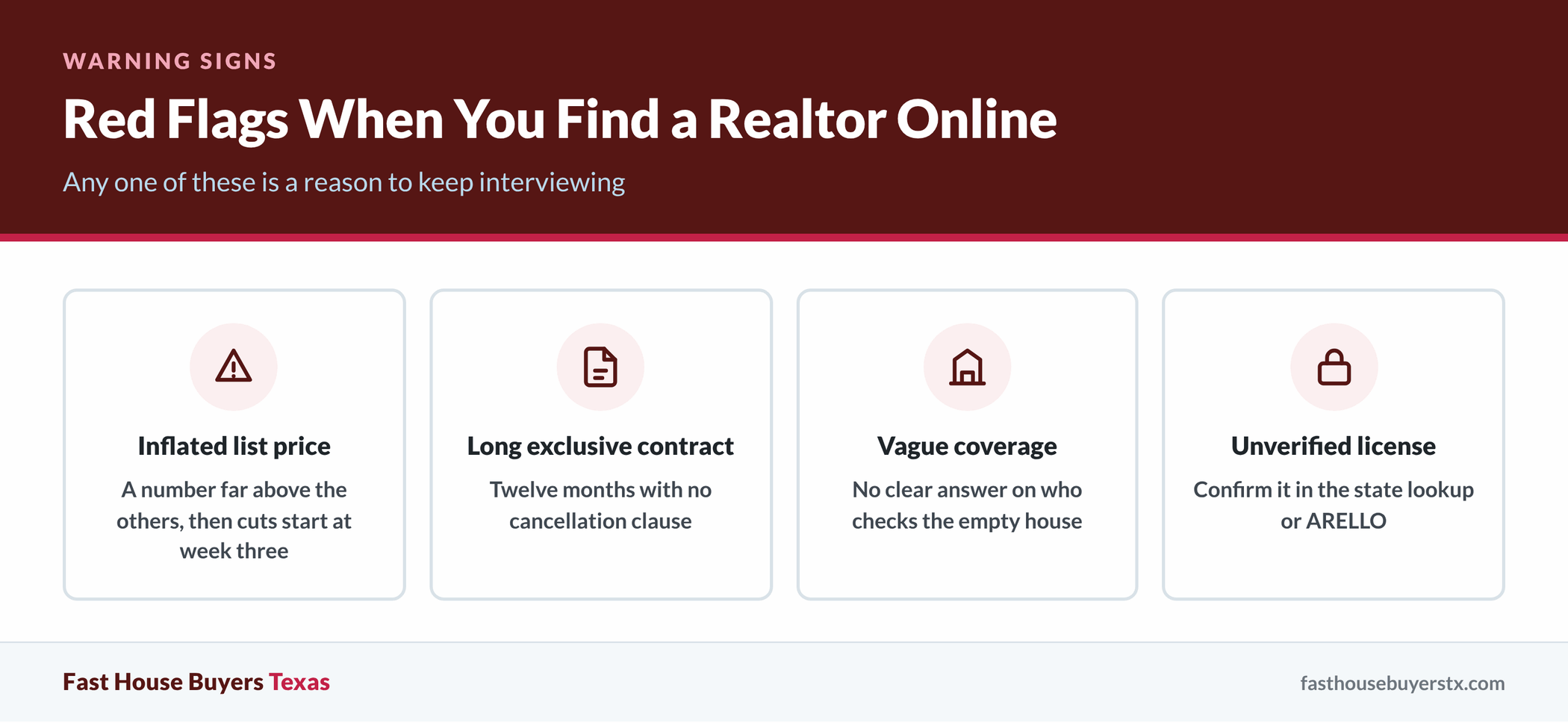
An inflated list price is the loudest warning sign. Some agents buy listings by promising a number they know won’t hold, then start the reduction conversation at week three. If one agent’s valuation sits far above the others, ask what comparable sales support it.
A second flag pops up when someone pressures you to sign a long exclusive agreement. Six months is standard in many markets; twelve months with no cancellation clause hands over your leverage completely. Negotiate the term, and get an out in writing.
That clause sounds minor until closing week.
Vague answers about who’s covering the property in your absence should end the conversation. A seller I worked with learned this when her listing agent “had someone checking in” and nobody had been inside for seven weeks. The dishwasher line had let go. Insurance covered part of it.
Unverifiable credentials appear more often than you’d hope. Anyone can write “realtor” on a website; the trademarked term means membership in the National Association of REALTORS, and a license is a separate thing issued by the state. ARELLO’s verification database pulls licensee records from more than 40 licensing regulators, so confirming one takes minutes.
An agent who dismisses every option except a traditional listing isn’t evaluating your situation.
How Much Does It Cost to Find a Realtor in Another State
Finding one costs nothing. Interviewing six costs nothing. The expense arrives at closing, and it’s the same whether you hired locally or from a thousand miles away.
An October 2026 survey of 682 agents across all 50 states and Washington, D.C. put the average total commission at 5.84%, with listing agents reporting 3.01% and buyer’s agents 2.84%. Rates aren’t set by law, and distance gives you no special discount.
Remote selling adds costs a local seller never sees. Lawn service, utilities kept on for showings, a cleaning crew before photos, and a property check service if the agent won’t do it. Budget for those as monthly line items, not one-time fees.
If a referral helped you find a realtor, the referral fee comes out of the receiving agent’s commission, not your pocket. If an agent tries to pass a referral fee to you as an add-on, that’s a billing problem worth questioning.
Some sellers skip the agent entirely and accept a lower price for speed. It’s a legitimate choice.
A landlord in Harlingen faced the squeeze version of all this. His transfer gave him five weeks to be out. His tenant had already left behind a garage full of paint cans and a broken treadmill. Two agents told him to budget for new flooring before listing. So he sold it as-is on a Thursday instead, and he was gone before the moving allowance expired. We bought it with the treadmill still there.
Selling direct sidesteps commission completely if your numbers look like that. For Texas homeowners we’re the people who handle these ourselves. Fast House Buyers Texas will give you a straight answer on whether listing beats selling direct in your case, even when the answer is listing.
Frequently Asked Questions About How to Find a Realtor in Another State
Where Do Most People Find Their Realtor?
Word of mouth wins by a wide margin. Friends, neighbors, and relatives account for the largest share of agent referrals, and sellers lean on repeat relationships even more than buyers do. Websites and open houses each bring in a small single-digit slice. If you’re relocating and don’t know a soul in the new market, your current agent’s professional network is the closest substitute for that neighborly recommendation.
Is a 3% Commission Normal for One Realtor?
It’s in the normal range, right in line with the listing-side average from the national survey cited earlier in this article. Commission has never been fixed by law, and the rate you agree to is genuinely negotiable, especially on higher-priced homes or when one agent handles both your sale and your next home. Ask what the agent charges, then ask what she’d do for a quarter point less. The worst answer you’ll get is no.
Do I Need a Realtor in Both States When I Move?
Usually, yes, unless one agent holds a license in both states. Selling the house you’re leaving takes an agent licensed where it sits, and buying in your new state takes one licensed there. Texas grants no reciprocity with any state, for example, so an agent from elsewhere can’t simply list a Texas house. Many sellers have their listing agent refer them to a buyer’s agent in the new market, which keeps both sides of the move talking.
Can I Sell My House Without Being There in Person?
Yes, and plenty of people do it every month. Remote online notarization, e-signature platforms, and wire transfers handle most of the mechanics, though the specific rules belong to the state where the property sits. Confirm the details with the title company or closing attorney handling your file before you pack the truck.
How Long Should I Spend Trying to Find a Realtor Before I Move?
Give yourself four to six weeks if you can. That’s enough time to interview three or four agents, run license lookups, call past clients, and do a live video walkthrough with your top choice. Rushing the search is how sellers end up with whoever answered the phone fastest, and that’s rarely the same person as the best fit.
Should I Find a Realtor or Sell Directly When I’m Relocating?
It depends on condition, equity, and how much supervision the property will need while you’re gone. A clean, updated house in a decent neighborhood usually nets more on the open market, even after commission. A house with deferred maintenance, a tight deadline, or no one nearby to manage it often pencils out better sold direct, because the carrying costs and repair bills eat the difference.
If you’re staring down a move and can’t decide whether to find a realtor or just sell the place and be done with it, we’re happy to talk it through with you. Tell us what you’re working with, and we’ll give you our honest read, including when listing is the better call. No pressure, no obligation, and no follow-up calls you didn’t ask for.
Selling a House in the Rio Grande Valley
Our office is in Harlingen, and we buy houses across the Rio Grande Valley.
Redfin’s mid-2026 review put the McAllen metro’s median sale price near $250,900 for January through June, with about 8.9 months of supply. That much inventory gives buyers room to wait, so an empty house can sit longer than a relocating owner planned. If yours is in the Valley, we buy houses in McAllen and the towns around it, as-is.
Talk With Us Before You Hire an Agent Long Distance
Moving soon and not sure whether to find a realtor or sell direct? Contact Fast House Buyers Texas and tell us about the house. We’ll give you a straight answer, and you can reach us through the form below.
Helpful Texas Blog Articles
- Who Pays Closing Costs When Selling a House in Texas
- Can You Sell a House With Termites in Texas
- Tax Implications of Selling a Home in Texas
- Selling a House With Water in the Crawl Space in Texas
- How to Sell Investment Property in Texas Without Losing Money
- How Much Does It Cost to Stage a House in Texas
- Can I Sell My House Before Paying Off the Mortgage
- How to Find a Realtor in Another State
- How Will Medicaid Know if I Sell My House