
About 59 percent of American homeowners still carry a mortgage, according to the Census Bureau’s 2025 survey, and people with a loan sell every single day. So the short answer to the question in the title is yes, and the longer answer is about how the mortgage payoff actually gets handled at the closing table. What varies is how much cash walks away with the seller.
The loan doesn’t follow you. It follows the house, and it gets cleared the day title transfers.
What Happens If You Fall Behind on Mortgage Payments?
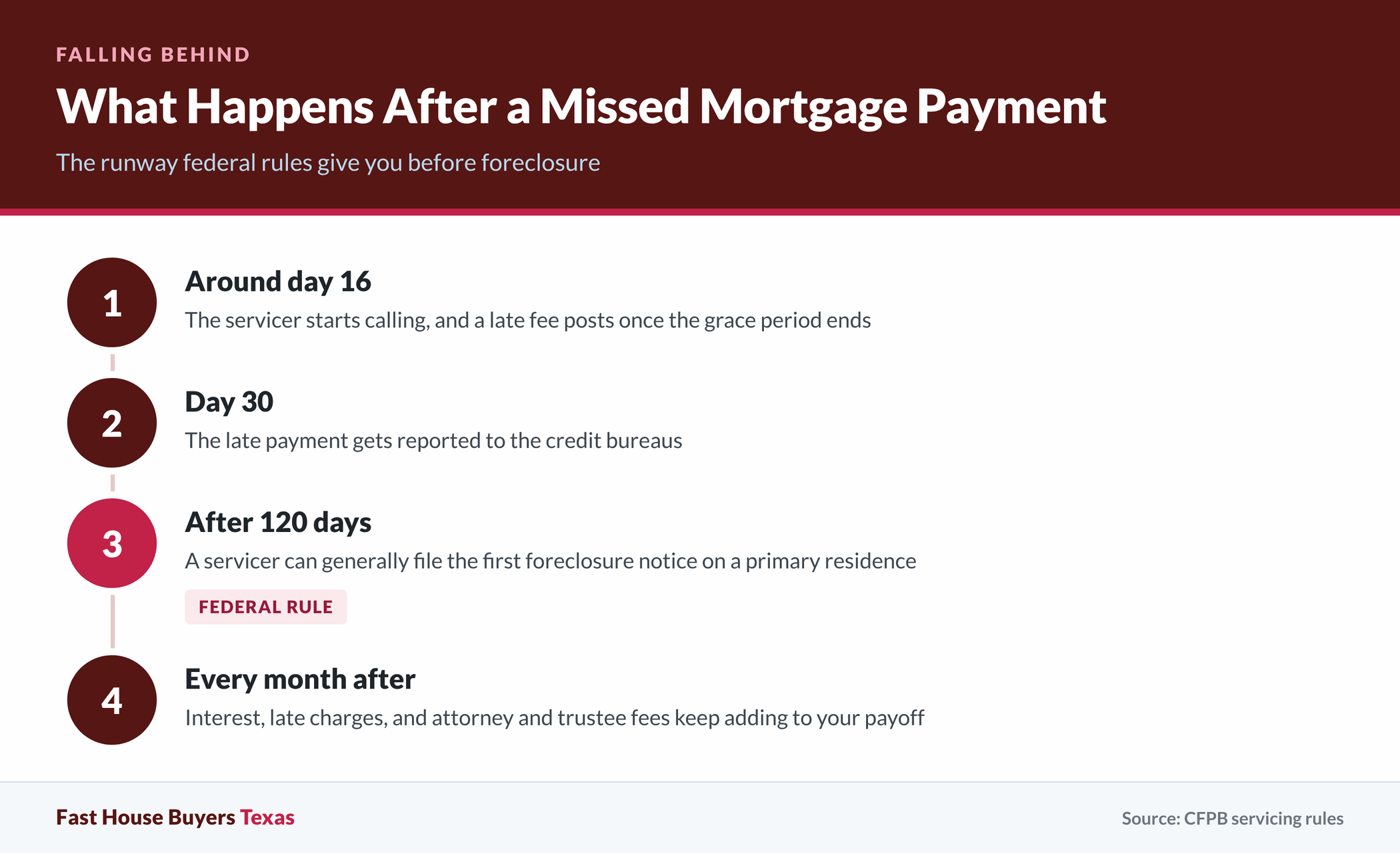
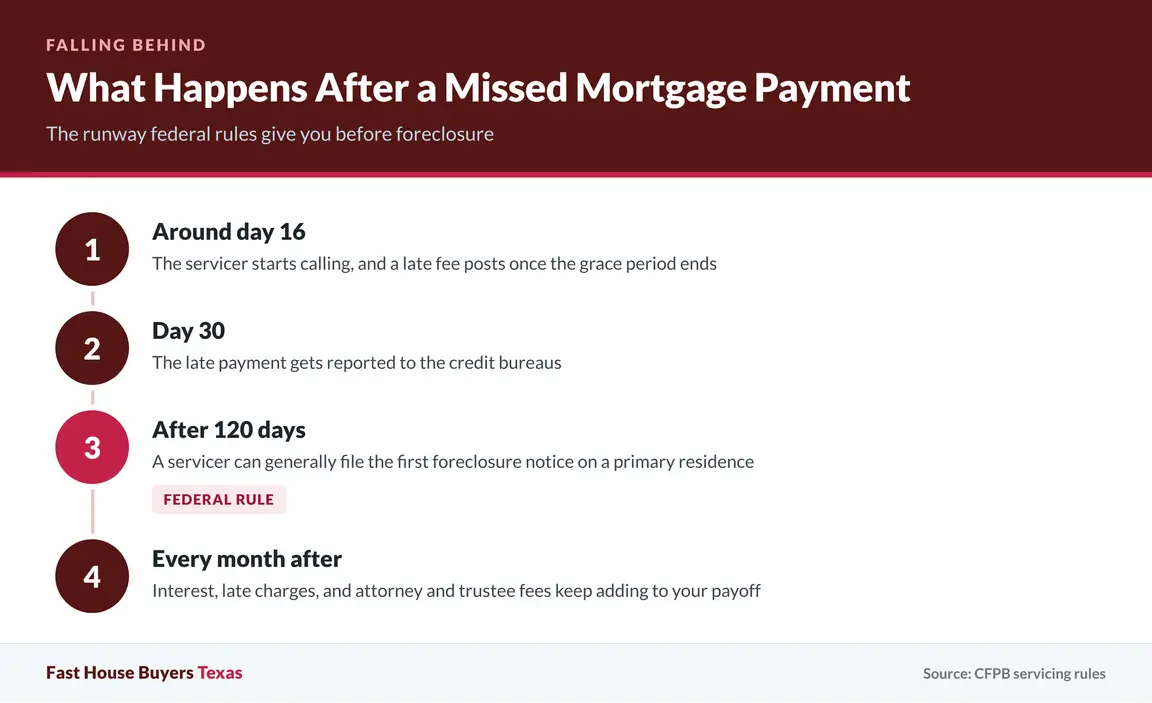
One missed payment is a paperwork problem. Four missed payments make it a legal one, and the gap between those two stages is where most homeowners lose their equity. Your servicer starts calling around day 16, which is usually right after a short grace period ends and a late fee posts. Credit reporting kicks in at 30 days.
Federal rules give you a real runway before anything official happens. Under the CFPB’s servicing regulations, a servicer generally can’t file that first foreclosure notice until you’re more than 120 days behind on a loan secured by your primary residence. The window exists so you can learn about workout options and apply for assistance. You can read the agency’s own plain-language summary of the foreclosure avoidance procedures at consumerfinance.gov. The rule has two narrow exceptions: a foreclosure based on a due-on-sale violation, or a servicer joining another lienholder’s foreclosure.
More people are in this spot than a year ago. ATTOM’s August 2026 report counted 40,277 properties with foreclosure filings nationwide, up 13 percent from a year earlier, which you can verify on ATTOM’s site.
Servicers sometimes agree to a workout. Often the modification offer that comes back raises your payment, because the arrears get rolled into the balance. Run the new number before you celebrate.
Every month you wait, the mortgage payoff figure grows. Unpaid interest, late charges, and eventually attorney and trustee fees all get added to what the loan requires to be satisfied. This means a payoff amount that was clean in month two can be several thousand dollars heavier by month six.
What Are Your Options Besides Selling to Stop Missing Payments?
Selling isn’t the only exit, and it isn’t always the right first call. A short hardship can often be handled with one phone call to your servicer.
Forbearance pauses or reduces payments temporarily. Ask which one before you sign, in writing.
Loan modification rewrites the terms permanently. Rate, term, balance, sometimes all three. These take months to process and the approval rate isn’t what homeowners hope.
Renting out a room or the whole house covers payments in some markets and falls short in others. Do you know what comparable rentals in your neighborhood actually bring in right now?
Refinancing is the option people mention next. Lenders check credit, though, and late payments tank it.
Then there’s selling. It stops the bleeding permanently, and the mortgage payoff turns whatever equity you have into cash instead of letting that balance eat it. That’s not a failure. A house you can’t afford is a monthly subscription to stress. Walking away with money in hand beats defending a losing position for another year.
Can You Sell a House That Still Has a Mortgage on It?
Yes, and people do it every day. Sale money pays the loan, usually before you leave the title company parking lot.
Nobody expects you to own the house free and clear. Your lender holds a lien, not the house. This lien is a recorded claim that has to be released before clean title passes to a buyer. Releasing it means paying the loan in full out of the sale proceeds.
It’s routine plumbing.
Here’s where the timing gets interesting. Federal law requires your servicer to produce an accurate payoff statement. Under 12 CFR 1026.36(c)(3) the statement must be sent within a reasonable time. In no case may it be sent more than seven business days after a written request. The full regulation text sits on Cornell’s Legal Information Institute. Seven business days that span two weekends can stretch past a calendar week and a half.
One pattern I keep seeing: sellers request the mortgage payoff verbally, get a number over the phone, and build their whole plan around it. Verbal quotes carry no legal deadline and no guarantee, so don’t trust one with your closing date. Put it in writing with your loan number and the date you plan to close.
Due-on-sale clauses sit in nearly every conventional mortgage. The balance comes due when ownership transfers, according to that clause, which is exactly what the mortgage payoff at closing accomplishes.
Some buyers offer to take over your payments without paying off the loan. That arrangement, often pitched as “subject-to,” is legal in form but gives the lender grounds to call the note.
How Much Do You Owe? Calculating Your Mortgage Payoff Amount
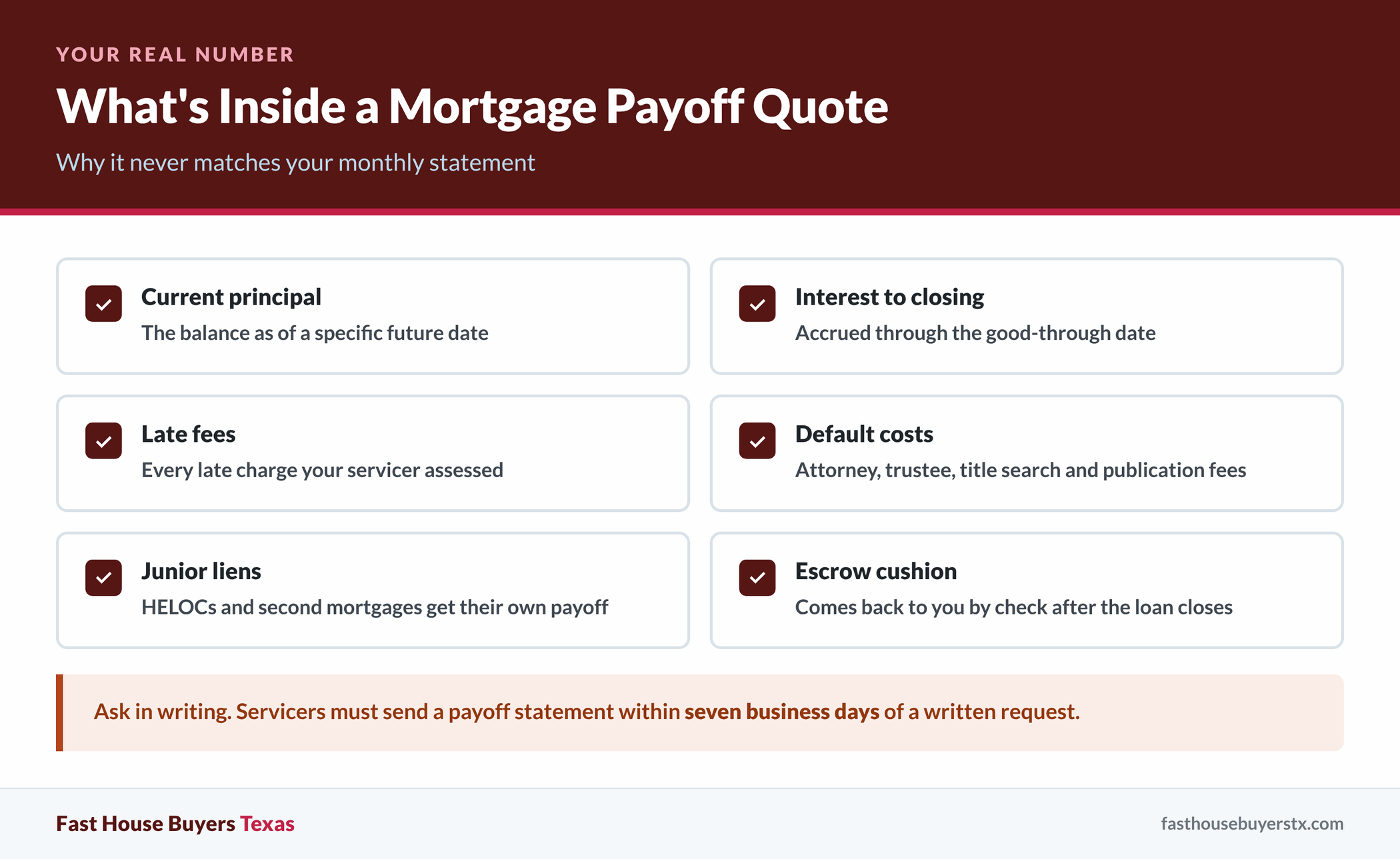
A payoff figure almost never matches the balance printed on your monthly statement. Your statement shows principal as of the last cycle. Budget off that number and you’ll come up short. A mortgage payoff quote shows principal plus interest accrued through a specific future date, plus any unpaid fees, escrow adjustments, and recording charges.
Lenders put a “good through” date on every payoff statement for this reason.
If closing slips past that date, the title company has to request an updated mortgage payoff, which can push a Friday closing to the following Tuesday.
Second mortgages, HELOCs, and home equity loans each need their own payoff statement. A solar panel lease or a PACE assessment may also attach to the property.
Prepayment penalties mostly disappeared from owner-occupied loans after the post-2010 lending reforms. They still appear in some non-qualified and investor loans. Read your note. Any such clause lives in the first few pages.
Escrow is the piece sellers forget to count in their favor. If your account carries a cushion for taxes and insurance, that money comes back to you after the loan closes, usually by check within a few weeks.
Add it up honestly: current principal, interest to the closing date, late fees if any, plus any junior liens. Your real mortgage payoff obligation is that total. It’s the number your sale has to clear before you see a dollar, and I’ve watched sellers underestimate it more than once.
What Happens to Late Fees and Penalties During Mortgage Payoff?
Every late fee you’ve been charged shows up on the mortgage payoff statement.
Late charges are typically a percentage of the monthly payment, set in your note, assessed once per missed payment.
The heavier item is usually default-related costs. Once a servicer refers a file to foreclosure counsel, the fees start getting advanced on your behalf. Attorney and trustee fees lead the list, followed by title search and publication costs. Those advances land on the mortgage payoff too. I’ve seen files that sat in foreclosure for months carry thousands in these charges beyond the missed payments themselves.
Reinstatement and mortgage payoff are different quotes. Reinstatement is what it takes to bring the loan current and keep it alive. Payoff is what it takes to end the loan entirely.
Servicers sometimes waive accumulated late fees at payoff, particularly when the alternative is a completed foreclosure that costs them more. Ask politely, in writing, before closing is scheduled. Worst case, they say no.
Foreclosures drag on longest in judicial states, where a court oversees every step. Nationally, properties foreclosed in the second quarter of 2026 averaged 563 days in the process, the shortest timeline since 2013, according to reporting on ATTOM’s midyear data at HousingWire. Eighteen-plus months of advancing fees onto your balance is eighteen months of equity leaving.
Selling before the referral to counsel keeps the mortgage payoff lean.
How Does Mortgage Payoff Work When You Sell?
“How do I know the lender gets paid and doesn’t come after me later?” Fair question, and the answer is that you’re not the one who sends the money.
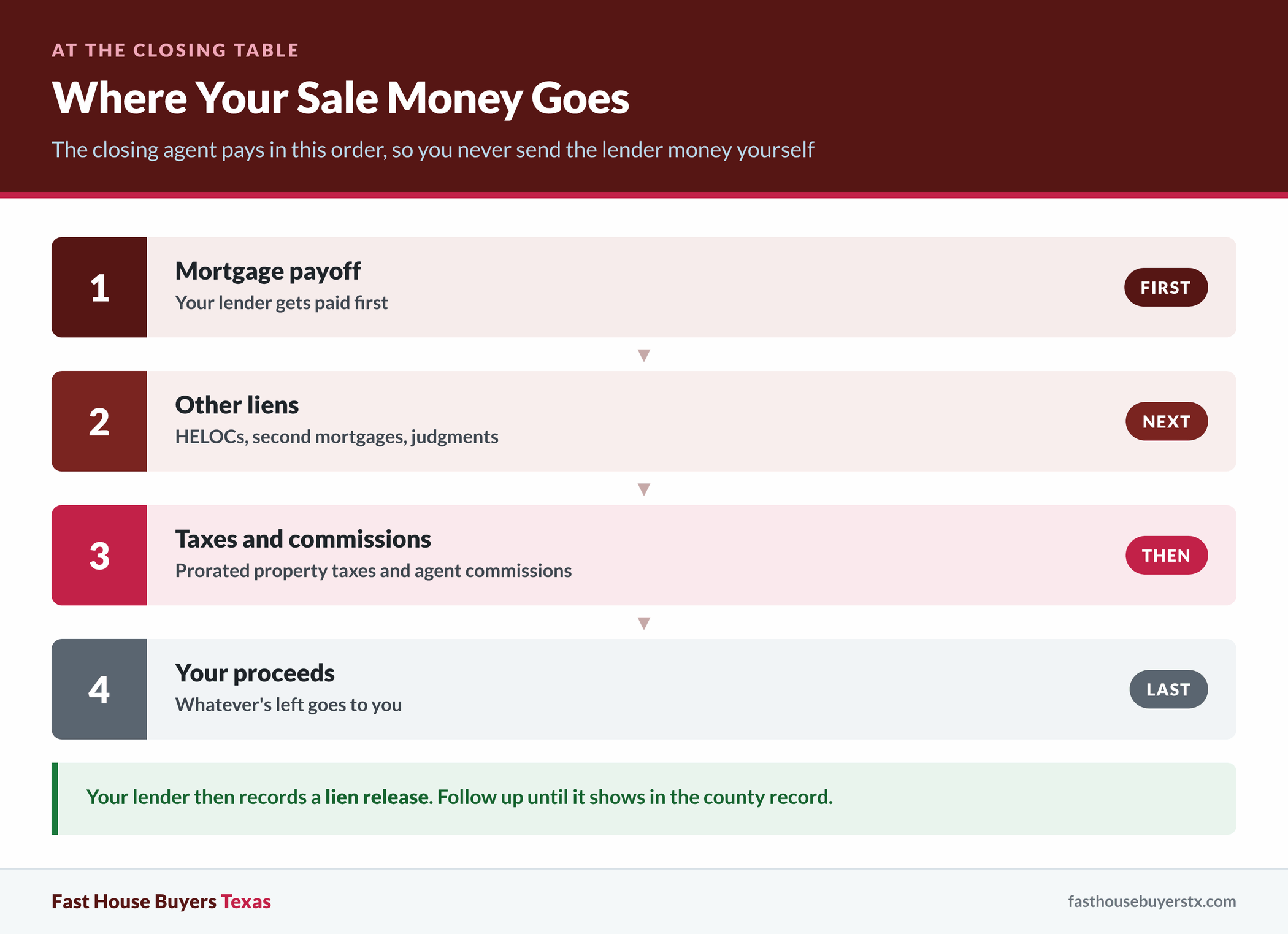
At closing, the buyer’s funds land in the closing agent’s escrow account. The agent then disburses according to a settlement statement you sign and review. Lenders get the mortgage payoff first, then any other liens get paid. Prorated property taxes and commissions come next, and whatever’s left goes to you.
Your lender wires back a lien release or satisfaction of mortgage, which gets recorded with your county. Recording it is the proof the debt is gone.
Follow up on it. Releases occasionally don’t get recorded, and a stray lien on a property you no longer own is a mess to untangle.
Sellers rarely expect how much timing matters from a cash-flow standpoint. If you make a regular monthly payment two days before closing, that payment may not be reflected on the mortgage payoff quote. You’ll get it refunded later rather than credited at the table.
Homeowners facing a deadline often work with a direct buyer. There’s no appraisal gap and no financing contingency to collapse the sale in week three. Fast House Buyers Texas handles the mortgage payoff coordination with the servicer the same way a traditional closing does, just on a compressed calendar.
If the sale price won’t cover the loan, the lender has to approve the sale and accept less than full satisfaction. You’d be waiting out their process on their timeline, not yours. Approval takes weeks or months and the lender may or may not waive its right to pursue the shortfall, depending on your state and the terms they offer.
Will Selling Cover Your Mortgage Payoff and Remaining Debt?
The national median existing-home price hit $416,700 in October 2026, up 0.4% from a year earlier and the 40th straight month of annual gains, per NAR data reported by HousingWire. With growth that flat, you can’t count on appreciation to bail out a thin equity position anymore.
Subtract your mortgage payoff total. Then subtract selling costs, which on a traditional listing run somewhere around six to ten percent of the sale price. Commissions, title charges, and whatever the buyer asks for in concessions make up that range.
Underwater means the mortgage payoff exceeds what the house will bring. Options narrow fast: short sale, deed in lieu, bringing cash to closing, or staying and fighting.
If you’d net five or ten thousand on a listing but have to make four more payments while it sits, a faster sale at a modestly lower price can leave you ahead. It’s worth running both scenarios with real numbers, including carrying costs, utilities, insurance, and the interest that keeps accruing.
How many months can you comfortably carry the house while it’s listed? If the answer is fewer than three, speed is worth paying for.
A HELOC you opened years ago has to be satisfied too, and a junior lienholder who won’t release for a reduced amount can stall a sale that otherwise pencils out.
Steps to Sell Your Home and Pay Off Your Mortgage Fast

Get the sequence wrong and you’ll be sitting at a closing table watching the title company explain that your mortgage payoff quote expired Tuesday and the wire has to wait.
First, request the payoff statement in writing from every lienholder. Name your target closing date.
Second, get a title search done before you market the property. Old judgments, contractor liens, and unreleased mortgages from previous refinances turn up all the time, and clearing them takes weeks you won’t have later.
Third, decide how you’re selling and commit. Listing with an agent gives you the broadest buyer pool. Median days on market in October 2026 was 35, up from 33 in September. Thirty-five days sounds quick until you add 30 to 45 days for a financed buyer’s closing. Two to three months from listing to funded, that is, assuming no inspection renegotiation and no appraisal problem.
Fourth, tell your servicer a sale is in progress. Servicers can sometimes postpone a scheduled sale date when a bona fide contract exists with a closing date in sight.
A tight deadline is where a direct cash sale earns its discount. Fast House Buyers Texas and buyers like us close in days rather than months because there’s no lender underwriting the sale. The mortgage payoff gets wired before the foreclosure sale is advertised, when your options are still open.
Fifth, after closing, confirm the lien release recorded and watch for your escrow refund.
Frequently Asked Questions About Mortgage Payoff When Selling
Can I Sell My House but Keep the Mortgage in My Name?
Not cleanly, and not without risk. Nearly every mortgage contains a due-on-sale clause that lets the lender demand full repayment when ownership transfers. Leaving the loan in place while deeding the property to someone else gives the lender grounds to call the balance. There are narrow exceptions, including some assumable VA and FHA loans where a qualified buyer formally takes over the debt with lender approval. Talk to a real estate attorney before you consider any arrangement where the mortgage payoff doesn’t happen at closing.
Should I Pay Off My Mortgage Early Before I Sell?
Usually not, if a sale is already on the calendar. A loan gets paid in full when the house sells anyway, so draining savings first only trades cash you can reach for equity you’ll get back later. Paying ahead makes sense for owners staying put with steady income and spare cash. If you’re behind, the better question is whether selling clears the debt and leaves you with something.
Should I Receive a Deed When I Pay Off My Mortgage?
You already hold the deed. What you get at the end of a mortgage payoff is a release of lien or satisfaction of mortgage from your lender. It’s recorded with your county so the public record shows the debt is cleared. In deed-of-trust states, that document is usually a deed of reconveyance from the trustee. If several weeks pass and nothing shows up, call your servicer and then check with your county recorder, because an unreleased lien creates real problems for the next owner.
How Long Does the Mortgage Payoff Process Take at Closing?
The payoff statement itself has a federal deadline, but the actual wire goes out the day funds are disbursed, typically the day of or the day after closing. Your lender then has to process it and record the release, which varies by servicer and county and can take anywhere from a couple of weeks to a couple of months. The debt stops accruing interest the day the money arrives, not the day the paperwork catches up.
What If My Sale Price Won’t Cover What I Owe?
You’re looking at a short sale, where the lender agrees to release the lien for less than the full mortgage payoff, or you bring cash to the table to make up the difference. Short sales need lender approval and take time, so starting early matters enormously. Some states bar lenders from pursuing the remaining balance after certain foreclosures or short sales, and others don’t, so get advice specific to where the property sits.
Does Selling with a Mortgage Hurt My Credit?
Selling and satisfying the loan in full doesn’t hurt your credit; the account simply reports as paid and closed. Any late payments you racked up beforehand stay on your report for up to seven years, and a short sale or deed in lieu lands harder than a clean sale. Getting a full mortgage payoff done before foreclosure is recorded is one of the better things you can do for your credit in a bad situation.
Selling a House With a Mortgage in the Rio Grande Valley
Our office is in Harlingen, and we buy houses across the Rio Grande Valley, mortgage or not.
Redfin’s mid-2026 review put the McAllen metro’s median sale price near $250,900 for January through June, with about 8.9 months of supply. A slower market can mean more monthly payments as a listing sits. When your house is in the Valley, we buy houses in McAllen and the towns around it, and the title company pays off your loan at closing.
Get a Straight Answer on Your Mortgage Payoff
Want to know whether a sale would clear your loan? Reach out to Fast House Buyers Texas and we’ll run the numbers with you. No cost, no pressure, and if listing with an agent is the better move for your situation, we’ll tell you so. You can reach us through the form below.
Helpful Texas Blog Articles
- Who Pays Closing Costs When Selling a House in Texas
- Can You Sell a House With Termites in Texas
- Tax Implications of Selling a Home in Texas
- Selling a House With Water in the Crawl Space in Texas
- How to Sell Investment Property in Texas Without Losing Money
- How Much Does It Cost to Stage a House in Texas
- Can I Sell My House Before Paying Off the Mortgage
- How to Find a Realtor in Another State
- How Will Medicaid Know if I Sell My House