
A deed transfer hits the public record within days of closing. It’s not a secret, and it’s not a conspiracy; county land records have always been public. So how will Medicaid know if you sell your house? What surprises families is how fast that record connects to a Medicaid benefits file. Caseworkers don’t need to follow you around. The sale leaves a paper trail in three or four places at once, and Medicaid eligibility workers know exactly where to look.
If you’re caring for a parent in a nursing home, or you’re the one on Medicaid and your house has gotten to be too much, you deserve straight answers. Not scare tactics. Let’s walk through what gets tracked, what you’re required to say, and what you can do about the money afterward.
What Counts as a Countable Asset Under Medicaid Rules?
A widow in a rehab facility kept paying taxes and insurance on a house she hadn’t slept in for eleven months. Her son assumed the house was “safe” because somebody told him Medicaid never touches a primary residence.
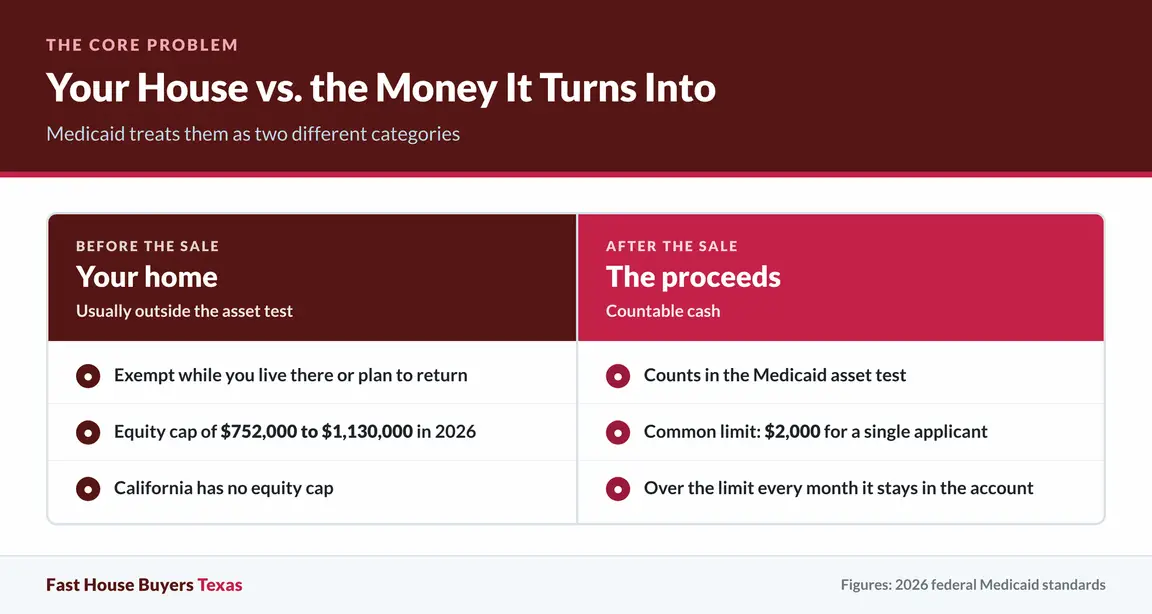
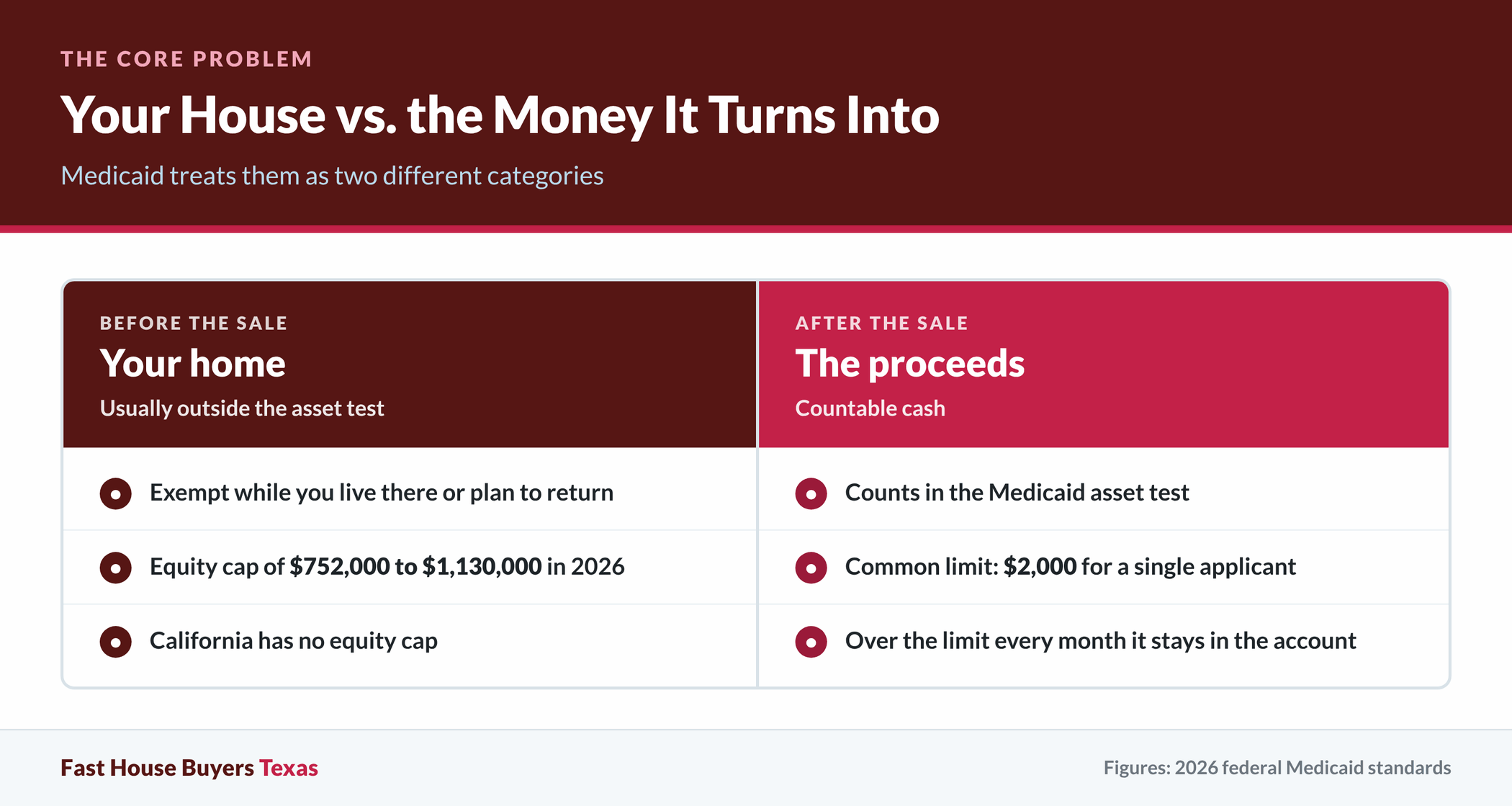
Half right. While you live in the home, or intend to return to it, your primary residence usually sits outside the asset test. This protection has a ceiling, though. Federal law sets a floor and a ceiling for Medicaid home equity limits, and each state picks a figure in that band. For 2026 the minimum is $752,000 and the maximum is $1,130,000, according to Medicaid Planning Assistance. California is the outlier with no equity cap at all.
Countable assets are the things Medicaid adds up against a very small limit, and for nursing home coverage in 2026, that limit is commonly $2,000 for a single applicant. Checking accounts, savings, CDs, stocks, a second property, a vacant lot. Cash from a closing table lands squarely in that pile.
Medicaid generally doesn’t count your car. It also ignores your furniture, clothes, and wedding ring.
So the house is one category and the money the house turns into is a completely different category, which is the whole mechanical problem in a sentence. A $280,000 asset that Medicaid ignored on Monday can disqualify you by Friday once it’s cash, and nothing about your actual life changed except the form the money took.
Do You Have to Report a Home Sale to Medicaid, and When?
That transformation is exactly what you’re obligated to tell somebody about. Reporting isn’t optional, and it isn’t a courtesy. Medicaid recipients have an affirmative duty to report changes in resources, and a ten-day window after the change is the common standard described by this eligibility guide. Your state may differ. Call your caseworker and ask for the number in writing before you sign anything.
What should you hand over? The closing disclosure, the deed, and the bank statement showing where the proceeds landed. Give the Medicaid office the whole packet at once.
I’d push back on advice I hear constantly: “wait until your renewal and sort it out then.” That approach turns a manageable spend-down conversation into an overpayment investigation. Medicaid agencies treat a late disclosure differently than a prompt one, even when the underlying facts are identical.
A couple of years ago I bought a place in Brownsville from an heir living three states away. She’d watched two agent listings expire with zero offers, mostly because the basement smelled like the sump pump had quit years earlier. One whiff was enough to kill every showing. By the time she called me, her mother’s Medicaid caseworker had already sent a letter asking about the property.
People usually treat timing as less important than it is. If the closing date and the reporting date are weeks apart, you’ve created a gap that somebody has to explain later, and I’ve watched sellers scramble to fill that exact gap. Report it to Medicaid the week it closes and the conversation stays about math instead of credibility.
How Does Medicaid Find Out You Sold Your House?
Fail to disclose, and the state can claw back every dollar of care it paid during the months you were technically ineligible. I’ve seen families blindsided by this, and that bill can run into six figures for nursing home care, following the recipient or the estate.
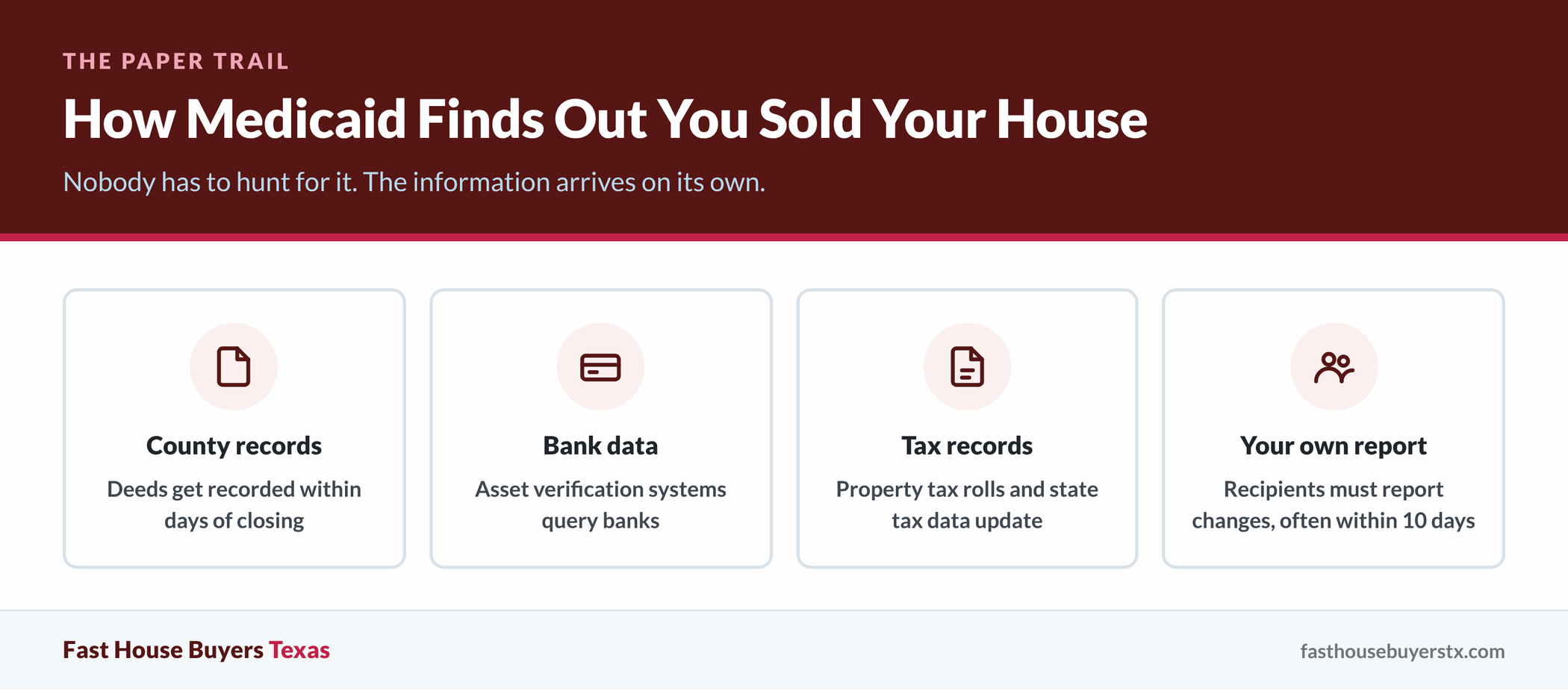
Now, the detection methods. Federal law requires every state Medicaid agency to operate an electronic asset verification system. The GAO has documented how those systems query banks and third-party data sources, including commercial records that cover real property. One state’s published Medicaid manual describes the process plainly: the automated system runs at new applications, at redeterminations, and when a case changes category, with electronic verification returning within about thirteen days. You can read Indiana’s version of that policy in its FSSA manual.
Then there’s your bank. Deposits the size of a home sale don’t blend in on a statement where the usual activity is a Social Security check and a pharmacy copay.
Deeds get recorded, and property tax rolls update right along with them. County land records capture the transfer within days, and Medicaid eligibility staff cross-reference applicant addresses against those records during verification. Add state tax data matching and you’ve got four independent paths to the same fact.
Does any of this mean somebody at Medicaid is actively hunting you? No. It just means the information arrives without anyone hunting, which is a different and more reliable thing. The families who get hurt are the ones who assumed silence equals invisibility, then had to explain a year of unreported resources to a Medicaid worker holding a printout.
How Does the Medicaid Estate Recovery Program Track Property Sales?
Before: a man on long-term care benefits owns a paid-off ranch house with a detached garage full of fishing gear. After: he passes, the house goes through probate, and his daughter opens a letter from the state’s recovery unit.
Medicaid estate recovery is a separate machine from eligibility. Before 1993 it was optional and roughly half the states bothered, but OBRA-93 made recovery from certain deceased recipients’ estates a mandatory condition of federal matching funds. Federal rules limit recovery to people who were 55 or older when they received benefits, along with certain institutionalized recipients.
Recovery units track property the same way Medicaid eligibility workers do, plus one more tool: probate filings. When an estate opens, the state Medicaid agency gets notice and files a claim.
The scope varies. Each state decides whether to pursue only probate assets or reach into non-probate assets too, and states may set a minimum claim threshold. That single choice explains why two families with identical circumstances get wildly different outcomes depending on the state line.
Selling during life doesn’t erase the obligation, though it does change its shape. Proceeds you spend on care, taxes, or your own living expenses are gone and unrecoverable, but money sitting in an account at death is fair game for a claim.
A home is shielded from recovery while a spouse, a minor child, or a disabled child still lives there, under federal rules. States are also required to waive recovery when it causes undue hardship, but federal law never defined hardship, so the standard swings widely from state to state. KFF tracks that variation if you want to see how uneven it gets.
How Does the Medicaid Look-back Period Affect Selling Your House?
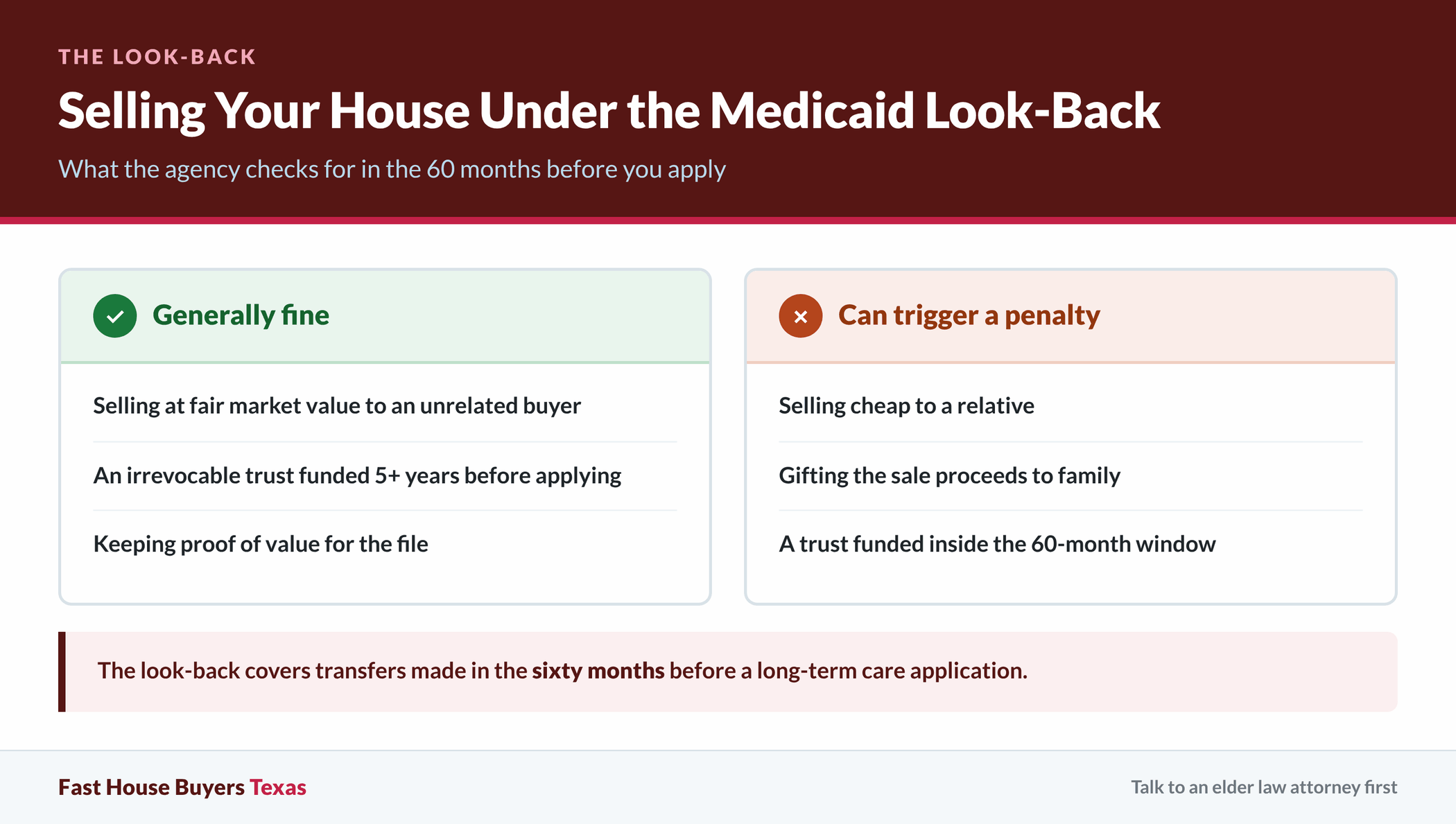
One detail often gets skipped: the review window applies to the application, not to your whole life on benefits. For long-term care Medicaid, that look-back covers asset transfers made in the sixty months immediately before your application date.
Selling at fair market value doesn’t trigger a Medicaid transfer penalty. You gave up a house and received money worth the same amount. The trade is even.
People get wrecked selling cheap to a relative. Medicaid treats transfers below fair market value as disqualifying and can impose a penalty period during which it won’t pay for long-term care services. Staff compare the sale price against the home’s fair market value. Deed your house to your nephew for a dollar and you’ve bought yourself a stretch of months paying privately for a nursing home.
Keep proof of value for the Medicaid file. An appraisal, a broker’s opinion, or documented comparable sales. I’ve watched families scramble for this paperwork a year after closing, and reconstructing it is miserable.
One structure genuinely works when it’s done early. Transferring your home to an irrevocable trust at least five years before applying for Medicaid removes it from countable assets and from your estate at death. Five years early, not five months. A trust funded inside the window does nothing except generate legal fees and a penalty.
An honest sale to an unrelated buyer, documented and reported, is one of the cleaner moves available. That’s part of why some families work with a direct buyer like Fast House Buyers Texas. The price is in writing, the timeline is known, and there’s no question about who the buyer is related to.
Can Selling Your House Make You Lose Medicaid Eligibility?
Yes, and anyone who tells you otherwise is selling something.
Think about the arithmetic for a second. The national median sale price was $388,634 in October 2026, with homes taking a median of 50 days on market, according to Redfin’s market data. Drop even half that figure into a checking account and you’ve blown past a two-thousand-dollar Medicaid limit nearly a hundred times over.
Losing Medicaid eligibility is usually temporary, not permanent. You’re over the limit in the month the money lands and in every month it stays there. Spend it down legitimately, and coverage resumes.
Is temporary a comfort when a nursing home charges by the day? Not much. Which is why the plan should exist before the closing, not after.
Regular Medicaid works differently from long-term care Medicaid, and I’ve seen this distinction trip up a lot of families. Many adults qualify through income rules alone, with no asset test and no home equity limit in play. A home sale affects those households through capital gains showing up as income, not through a resource count. Ask which program you’re actually enrolled in before you assume anything.
The sale being reportable doesn’t make it wrong. A deteriorating house drains money that could pay for care, and I’ve met more than a few families who kept a property out of sentiment as the roof quietly ate their savings.
What Happens to Sale Proceeds When You’re on Medicaid?
“Can I just give the money to my kids?”
No. Medicaid treats that as a disqualifying transfer, and it restarts the exact problem the look-back exists to catch. Gifting proceeds is the single most expensive mistake available to you here.
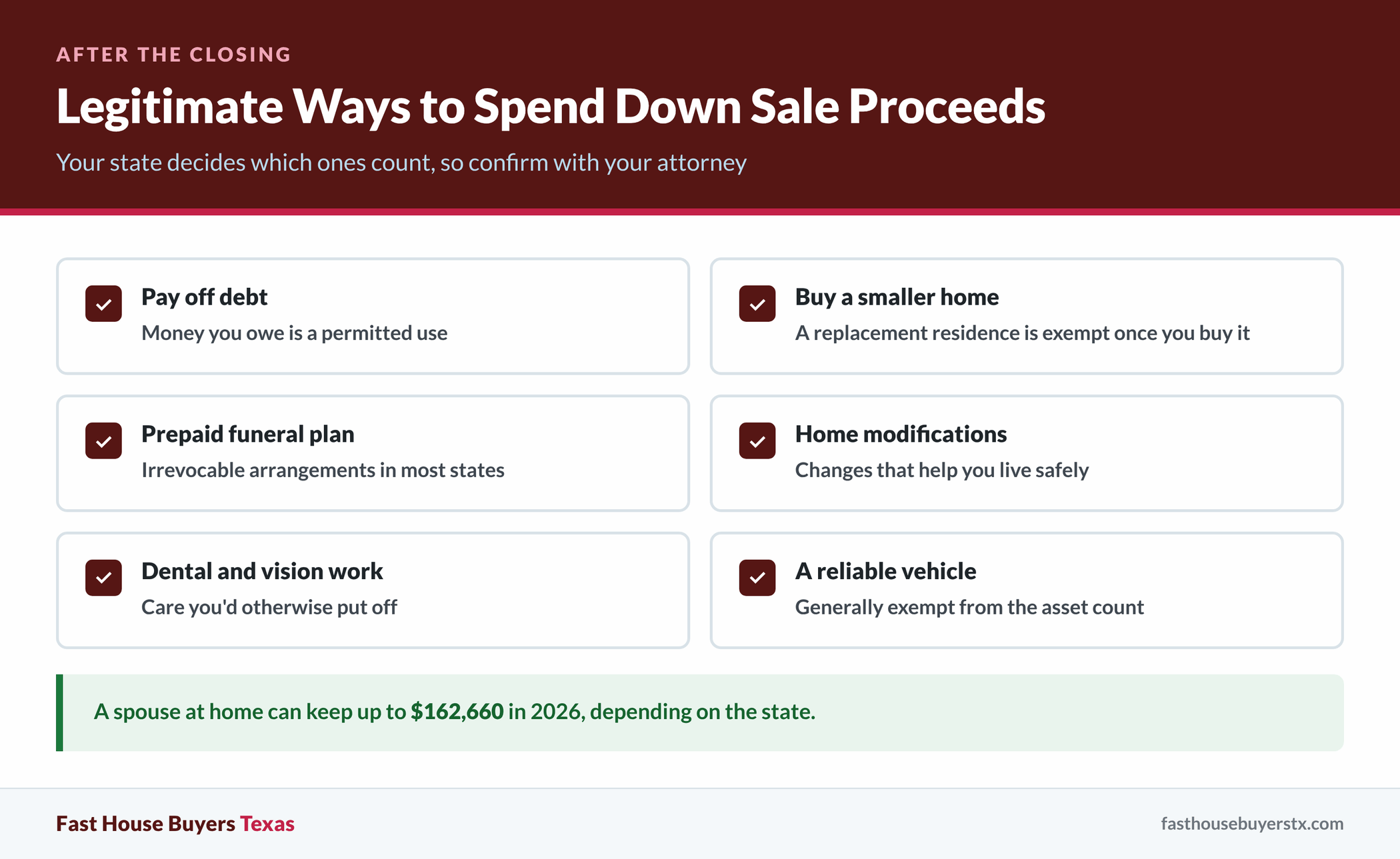
What does work is spending the money on things you’re allowed to own or owe. Paying off debt counts. So does buying a smaller home to live in. A replacement residence becomes exempt the moment you buy it, and the money used counts as a permissible transfer rather than a countable Medicaid asset.
Prepaid irrevocable funeral arrangements, home modifications, dental and vision work, a reliable vehicle: all legitimate categories in most states. Your attorney will know which ones your state Medicaid program recognizes.
For a married couple, there’s real breathing room. A spouse remaining at home can keep up to $162,660 in 2026, depending on the state, according to the 2026 federal Medicaid resource standards.
Pooled trusts and qualified income trusts handle some situations well, and some states require them. Document every dollar that leaves the account. Bank statements, receipts, invoices with dates. When the caseworker reviews your file, a clean record turns a three-month headache into a twenty-minute phone call.
What Should You Do Before Selling a House While on Medicaid?
Fifty days to a contract is the national median, but that figure describes a clean house in a desirable spot. Add a failed inspection, a buyer whose financing wobbles, and a month of back-and-forth, and a typical listing stretches well past the quarter mark. Meanwhile the facility bills monthly.
Call an elder law attorney who handles Medicaid planning first. Before the listing, before the cleanout, before you tell anyone your plan. A consultation costs a fraction of one month of nursing home care and routinely saves families five figures.
Then get your Medicaid caseworker on the phone and ask three questions: what’s my reporting deadline, what documents do you want, and what spend-down categories does this state accept?
Price it honestly. An arm’s-length sale at market value protects you; a sweetheart sale to a relative does not.
A seller near Edinburg called me after four years of landlording a duplex he inherited and never wanted. The last tenant had left a chest freezer and a dirt bike in the garage, rent was three months behind, and he was done. We closed as-is, freezer and dirt bike included, and he used the proceeds to cover his mother’s care without a single transfer Medicaid could penalize. If a straightforward timeline matters more to you than squeezing out the last few thousand, Fast House Buyers Texas is worth a call.
Frequently Asked Questions About How Medicaid Finds Out You Sold Your House
Is Selling a House Considered Income for Medicaid?
Sale proceeds generally aren’t treated as earned income the way wages are. Under the Texas rules for long-term care Medicaid, money from selling your house isn’t income at all. It’s the same asset in a new form, and whatever you still hold counts as a resource starting the month after the sale. That resource count is what pushes people over the asset limit, so the timing matters more than the label. Your capital gains picture is a separate tax question worth raising with whoever prepares your return.
How Do You Remove a Medicaid Lien From a Property?
Liens typically come off through payment, through a successful hardship waiver, or because one of the categorical protections applies to your situation. The recovery unit in your state is the office that releases it, and they’ll tell you exactly what documentation they need. An elder law attorney can also negotiate the claim amount in some states, especially when the estate is small. Don’t try to sell a property with an outstanding lien without addressing it first, because title won’t clear.
How Often Does Medicaid Check Your Income and Assets?
At minimum, every renewal cycle, which is usually annual for most programs. Long-term care cases get looked at more closely because the resource test never stops applying. The automated verification systems described earlier also run at applications and whenever a case category changes, so checks happen outside the renewal calendar too. Your own duty to report changes to Medicaid exists in between all of those reviews.
What Assets Are Exempt From Medicaid Estate Recovery?
There’s no single national list, which frustrates everyone who asks this question. Personal belongings, household goods, and property jointly held with survivorship rights commonly fall outside recovery. Assets properly placed in an irrevocable trust well ahead of the look-back window described above are generally protected, as are homes shielded by the surviving-family rules. Because your state decides whether recovery reaches beyond the probate estate, the honest answer is that you need state-specific advice.
Can I Sell My House and Stay on Medicaid at the Same Time?
Often yes, if the sale is at fair market value, reported on time, and followed by a legitimate spend-down or reinvestment. Families run into trouble when they sell quietly, park the cash, and hope nobody notices. Plan the spend-down before the closing date so the money has somewhere to go the week it arrives. Coordinating the sale with your attorney and your caseworker turns this from a crisis into paperwork.
If you’re weighing a sale while Medicaid is in the picture, talk to an elder law attorney first, then figure out the house. We’re glad to look at your property and give you a straight number so you know what you’re working with. No pressure, no obligation, and no hard feelings if the timing isn’t right.
Selling a House in the Rio Grande Valley
Our office is in Harlingen, and we buy houses across the Rio Grande Valley.
Redfin’s mid-2026 review put the McAllen metro’s median sale price near $250,900 for January through June, with about 8.9 months of supply. Inventory like that gives buyers time to wait, which matters when a care facility bills by the month. If a parent’s house sits in the Valley, we buy houses in McAllen and the towns around it, as-is.
Talk With Us Before You Sell a House on Medicaid
Talk to your elder law attorney first, then contact Fast House Buyers Texas for a straight number on the house. You can reach us through the form below, with no pressure and no obligation.
Helpful Texas Blog Articles
- Who Pays Closing Costs When Selling a House in Texas
- Can You Sell a House With Termites in Texas
- Tax Implications of Selling a Home in Texas
- Selling a House With Water in the Crawl Space in Texas
- How to Sell Investment Property in Texas Without Losing Money
- How Much Does It Cost to Stage a House in Texas
- Can I Sell My House Before Paying Off the Mortgage
- How to Find a Realtor in Another State
- How Will Medicaid Know if I Sell My House